
Laundry & Dry Cleaning Franchise India: Costs & Unit Economics

Walk through any residential lane in Bengaluru's HSR Layout or Mumbai's Andheri West and you'll spot at least two laundry storefronts within 500 metres. This isn't coincidence — it's the visible edge of a category that's quietly consolidating from unorganised dhobi networks into branded, tech-enabled franchise chains. For a first-time founder with ₹10-40 lakh, laundry and dry cleaning offers something rare: predictable demand, low SKU complexity, and a franchise model mature enough to have real benchmarks.
But "laundry franchise" spans wildly different businesses — a 150 sq ft pickup-drop kiosk and a 600 sq ft store with in-house dry cleaning machines sit at opposite ends of both cost and complexity. Getting the tier right matters more than the brand you pick.
Why Laundry Franchises Are Scaling Now
Three structural shifts are driving this. First, dual-income urban households in Tier-1 and Tier-2 cities have less time and more willingness to outsource chores — NSSO consumption data shows urban discretionary spend on household services growing faster than overall consumption since 2022. Second, real estate and rental costs for small-format retail (100-400 sq ft) have stayed relatively flat in secondary micro-markets even as Grade-A retail rents spiked. Third, hyperlocal delivery infrastructure (your own riders or aggregator tie-ups) has made 24-48 hour turnaround commercially viable even for solo-operator outlets.
The unorganised sector is still 80%+ of the market
Most Indian households still use the neighbourhood dhobi or an unbranded dry cleaner. That's the opportunity: franchise brands aren't fighting each other for share as much as they're converting unorganised spend, which means a well-located outlet doesn't need to "win" a competitive fight — it needs visibility and consistent quality.
Setup Costs: What ₹10-40 Lakh Actually Buys
Tier 1: ₹10-15 lakh — Pickup & drop kiosk model
This is a collection-point format with no on-site heavy machinery. Franchise fee typically runs ₹2-4 lakh, interiors and branding ₹3-5 lakh, a starter equipment set (steam iron, packing station, basic washer for local minor jobs) ₹2-3 lakh, and working capital plus deposits ₹2-3 lakh. Processing is outsourced to a central hub. Margins are thinner (18-22% gross) because you're paying a hub fee per garment, but breakeven is faster since fixed costs stay under ₹1.2 lakh/month.
Tier 2: ₹15-25 lakh — Standard store with in-house wash
Here you invest in commercial washers (₹3.5-6 lakh for 2-3 machines), a dryer (₹1.5-2.5 lakh), and a basic dry-cleaning unit or press table (₹2-4 lakh) alongside franchise fee (₹3-5 lakh) and interiors (₹4-6 lakh). This format captures more margin per order (28-35% gross) because processing happens on-site, but power and water costs rise — budget ₹18,000-30,000/month extra for utilities in Mumbai, Delhi NCR, or Pune.
Tier 3: ₹25-40 lakh — Flagship store with full dry-cleaning line
This includes a proper dry-cleaning machine (₹8-14 lakh depending on capacity), higher-capacity washers and dryers, premium interiors for a 400-600 sq ft space, and often a small delivery fleet (2-3 two-wheelers, ₹1.5-2.5 lakh). Franchise fees at this tier often run ₹5-8 lakh with a 5-8% royalty on revenue. These stores can service both retail walk-ins and B2B contracts (hotels, salons, hospitals), which materially changes the revenue mix.
Unit Economics: The Monthly P&L Reality
Revenue mix by service line
A mid-tier store (₹15-25 lakh setup) in a city like Pune or Hyderabad typically sees this order mix: wash-and-fold (40% of orders, ₹40-70 per kg), dry cleaning (35% of orders, ₹80-250 per garment), and steam pressing/express services (25% of orders, ₹30-60 per piece). Average order value across formats usually lands between ₹280-450.
A store doing 25-35 orders/day at this AOV generates monthly revenue of roughly ₹2.5-4.5 lakh. Gross margins after direct costs (chemicals, packaging, per-order hub or utility cost) typically run 30-38% for in-house processing formats.
A representative monthly P&L (₹18 lakh setup, Tier-1 city)
- Revenue: ₹3.2 lakh
- Direct costs (chemicals, packaging, power): ₹1.05 lakh
- Rent (300 sq ft, secondary market): ₹35,000-55,000
- Staff (2-3 people): ₹45,000-60,000
- Royalty (6% of revenue): ₹19,200
- Marketing/local promotions: ₹10,000-15,000
- Net margin before owner draw: 12-18%, i.e. ₹38,000-58,000/month
Breakeven on the ₹18 lakh investment, assuming steady ramp-up, typically falls between 22-30 months — faster in high-footfall micro-markets, slower where you're building awareness from scratch.
Key takeaway: In laundry franchising, the equipment tier you choose determines your margin ceiling, but location determines whether you ever reach it — a ₹25 lakh flagship store in a low-footfall lane will underperform a ₹15 lakh kiosk on a high-traffic residential road.
Location Strategy: Reading Indian Micro-Markets
What actually predicts footfall
Don't chase "high street" visibility — laundry is a convenience purchase, not an impulse one. The strongest predictor is residential density within 800 metres, specifically apartment complexes with 150+ units, working professional demographics, and limited existing organised competition. A 24×7 kirana or pharmacy nearby is often a better co-location signal than a mall entrance.
City-specific notes
- Bengaluru & Pune: IT-corridor residential belts (HSR, Whitefield, Wakad, Hinjewadi periphery) have high dual-income density and strong app-based order adoption — prioritise delivery-capable formats here.
- Mumbai & Delhi NCR: Rents are the binding constraint; a 150-200 sq ft kiosk model in a mid-rise residential society cluster often outperforms a larger store in a costlier main-road location.
- Hyderabad & Chennai: Gated community penetration is rising fast in outer zones (Gachibowli, OMR) — early entry into new residential clusters before competitors arrive gives a 12-18 month advantage window.
- Kolkata: Price sensitivity is higher; wash-and-fold volume plays outperform premium dry-cleaning positioning in most neighbourhoods outside South Kolkata's affluent pockets.
Avoid the ground-floor trap
Many franchisors push ground-floor retail because it's easier to sell, but a first-floor or interior lane unit at 40-50% lower rent, paired with strong Google Maps/WhatsApp ordering and clear signage, often delivers better unit economics for this category since most customers don't browse — they order for pickup.
Operational Risks Worth Planning For
Garment liability and quality complaints
Dry cleaning carries reputational risk from damaged or lost garments. Budget for a garment-insurance clause in your franchise agreement and maintain a documented intake process (photos at drop-off) — this alone reduces dispute-related refunds by a meaningful margin in most operator experiences.
Staffing turnover
Press and wash staff turnover in this category commonly runs 25-35% annually. Factor recruitment and training costs of ₹8,000-15,000 per hire into your working capital, not just your initial budget.
Matching Capital Tier to Your Risk Appetite
If you have ₹10-15 lakh and want faster breakeven with lower operational complexity, the kiosk model suits first-time operators. If you have ₹15-25 lakh and can commit to hands-on quality control, the in-house wash format offers the best margin-to-complexity ratio. The ₹25-40 lakh flagship tier only makes sense if you're also targeting B2B contracts (hotels, salons) — without that second revenue stream, the extra capex rarely pays back faster than a mid-tier store.
Before signing any franchise agreement, run the numbers against your specific micro-market rather than the franchisor's national average projections — a free structured assessment, like VentureKhoj's 8-question feasibility tool, can help you sanity-check capital tier and location fit before you commit deposit money.
---
What’s Next: Choosing the Right Laundry Brand Partner
While selecting the right capital format, machinery tier, and residential catchment sets your operational base, partnering with an established franchisor provides proven eco-friendly chemical supplies, staff training, and proprietary POS/app order-tracking tech.
👉 Coming Up in Part 2: We spotlight the **Top 3 Laundry & Dry Cleaning Franchises to Partner With in India (2026)
---
Explore Verified Laundry Opportunities on VentureKhoj
VentureKhoj connects serious investors directly with pre-screened laundry and dry cleaning franchisors across India.
Browse verified brand listings, download official partner decks, and calculate your target ROI directly on our category hub:
👉 Explore the Laundry & Dry Cleaning Category on VentureKhoj →
Frequently asked questions
What is the minimum capital needed to start a laundry franchise in India in 2026?
A basic pickup-and-drop kiosk model can be started with ₹10-15 lakh, covering franchise fee, interiors, and a small equipment set. In-house processing stores with washers and dryers need ₹15-25 lakh, while full dry-cleaning flagship stores typically require ₹25-40 lakh.
How long does it take to break even on a laundry franchise?
Most mid-tier stores (₹15-25 lakh setup) break even in 22-30 months, depending on location footfall and ramp-up speed. Kiosk-format outlets with lower fixed costs can sometimes break even faster, in 18-24 months, if placed in high residential-density micro-markets.
Which is more profitable: dry cleaning or wash-and-fold services?
Dry cleaning carries a higher per-garment margin (often ₹80-250 per piece) but lower order volume, while wash-and-fold has lower per-kg pricing (₹40-70/kg) but higher volume and more predictable demand. A balanced order mix typically delivers the most stable monthly revenue.
Do laundry franchises require heavy machinery investment?
Only if you choose the in-house processing or flagship tier. Pickup-and-drop kiosk models outsource washing and dry cleaning to a central hub, avoiding the ₹8-14 lakh cost of a commercial dry-cleaning machine, but they earn a thinner margin per order in exchange.
What location factors matter most for a laundry business in Indian cities?
Residential density within 800 metres, presence of 150+ unit apartment complexes, working professional demographics, and limited organised competition matter more than main-road visibility. Since laundry is a convenience purchase, interior lanes with strong digital ordering can outperform expensive high-street locations.
Can I run a laundry franchise part-time or does it need full-time involvement?
Kiosk-format franchises with outsourced processing need less daily supervision and can work with a part-time owner-operator plus staff. In-house processing and flagship formats require closer quality control due to garment handling risk, making them better suited to full-time involvement, at least in the first 12-18 months.
Business ideas matched to this article

Home Cleaning Services
On-demand home cleaning & deep clean
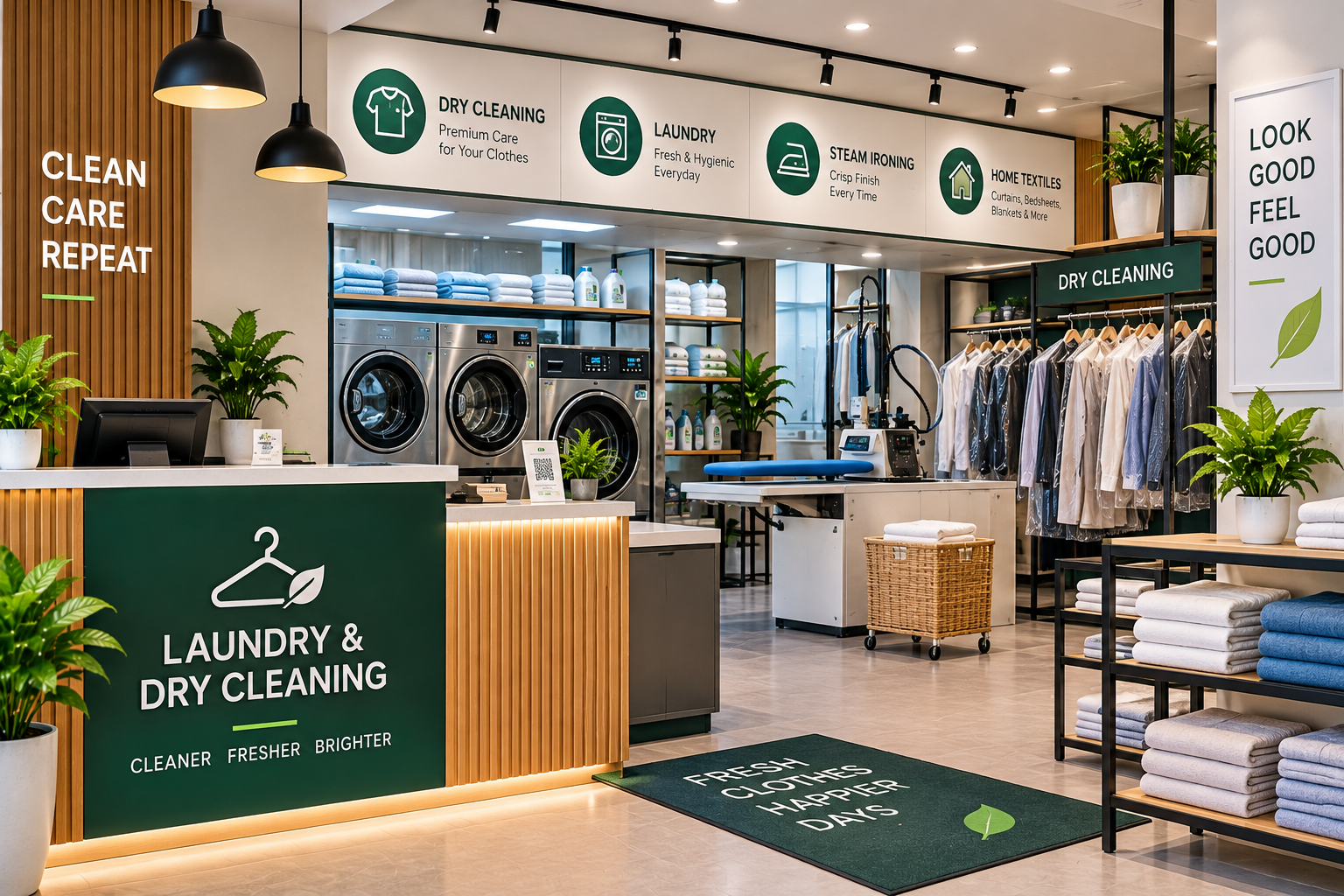
Laundry & Dry Cleaning
Neighbourhood laundry-and-dry-cleaning outlet with pickup-and-delivery on WhatsApp

Pharmacy Retail Store
Neighbourhood chemist with generic + branded medicines and OTC wellness range

Unisex Salon
Modern beauty & grooming studio
Explore in these cities
Ready to explore your Laundry business?
Check whether this business suits you or calculate the numbers for your city.
Related reading
GST, FSSAI & Licenses: What You Need in the First 90 Days
A no-nonsense checklist for the paperwork you actually need — and the ones you can postpone.
How to Start a Home Cleaning Services Business in India (2026): Cost, Profit & Step-by-Step Guide
How to start a home cleaning services business in India: investment (₹3 lakh–₹5 lakh), cost breakdown, revenue model, team, licences, risks and a 90-day launch plan.
Smart Vending Machine Business in India: Setup Costs, Unit Economics, and High-Footfall Locations
A practical breakdown of what it really costs to run vending machines in India, the margins you can expect, and where to place them for maximum daily transactions.
12 Best Business Ideas in Gurgaon for 2026 (With Real Costs)
From cloud kitchens near Cyber City to pet care in gated societies, here's a data-backed look at what actually works for founders starting up in Gurgaon.
Best Franchise Businesses in India: Capital, Margins & ROI
A data-backed ranking of 9 franchise categories in India, with real capital, margin and payback numbers by city tier — so you shortlist before signing any agreement.