
How to Start a Mushroom Cultivation Unit Business in India (2026): Cost, Profit & Step-by-Step Guide
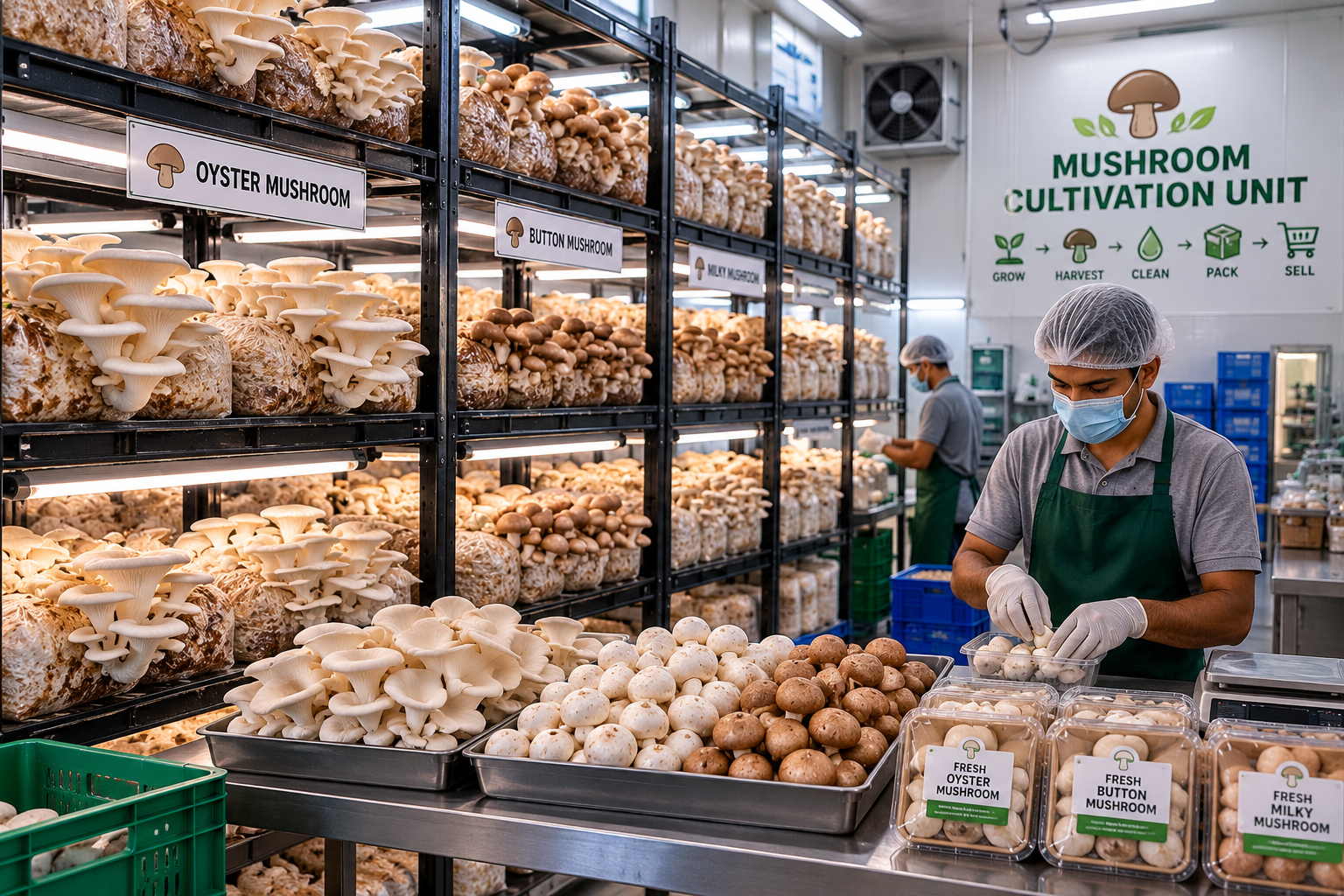
Oyster & button mushroom farming in a controlled climate room for weekly harvests. Insulated 400–1200 sq-ft climate-controlled shed producing 40–120 kg of oyster and button mushrooms per week. Sell channels: local Reliance Fresh/BigBasket procurement + hotels + modern-trade contracts. Spawn quality and humidity discipline (85–92% RH) are the moat.
If you are evaluating a mushroom cultivation unit business in India, this guide covers the investment you need, where the money goes, how revenue builds up, the team required, the risks to plan for, and a 90-day launch plan — the same framework VentureKhoj uses in its feasibility reports.
Still deciding whether a mushroom cultivation unit suits your capital, city and skills? Find My Best-Fit Business in 8 quick questions.
Mushroom Cultivation Unit business at a glance
| Metric | Standard estimate |
|---|---|
| Investment range | ₹3 lakh – ₹5.5 lakh |
| Recommended capital | ₹4 lakh |
| Typical payback | ~22 months |
| Gross margin | 34% |
| Risk level | Medium |
| Time commitment | Full Time |
| Works best in | Tier-2 cities, Tier-3 cities, small towns |
How much does it cost to start a mushroom cultivation unit business?
Most aspiring entrepreneurs launch a mushroom cultivation unit with ₹4 lakh in a Tier-2 city. Metro rents and fit-outs push the figure towards ₹5.5 lakh, while small towns can start closer to ₹3 lakh. Here is how the recommended budget is typically split:
Fixed costs (do not change much with city)
Typical fixed-cost line items for a mushroom cultivation unit: Equipment & Machinery, Licences & Registrations, Technology / Software, Contingency.
Variable · city-linked costs
City-linked line items you will budget for: Security Deposit / Advance Rent, Interiors & Fit-outs, Furniture & Fixtures, Initial Inventory, Initial Marketing, Working Capital (3–6 months).
🔒 The exact amount and budget share for each of these 10 line items is part of the full commercial details for Mushroom Cultivation Unit. Unlock it with the ₹99 Explore plan.
Prefer numbers tuned to you? Calculate My Business Numbers to re-base every line item to your own capital and city.
Revenue model: how a mushroom cultivation unit makes money
For a ₹4 lakh setup, revenue is built from daily customers, average ticket size, operating days and gross margin — netting out fixed and other monthly costs to arrive at your monthly profit, break-even and ROI.
🔒 The full revenue maths — daily customers, average ticket, monthly revenue, gross & net profit, break-even months and Year-1 ROI is part of the full commercial details for Mushroom Cultivation Unit. Unlock it with the ₹199 Compare plan.
What drives revenue up or down:
- Yield / animal × price realised
- Direct-market / D2C premium
- Second-cycle & by-product revenue
- Subsidy & insurance
Typical profit margin range: 10–40% (Highly variable — depends on cycle, weather & buyer).
Cost structure to watch
- Feed / seeds / inputs (35–55%)
- Labour (10–20%)
- Land lease / EMI
- Vet / crop-protection
Working-capital items to budget for:
- Feed / inputs full crop / animal cycle
- Salary + vet buffer
- Insurance premium float
- Season-to-market gap
Team and equipment
Staffing you will typically need:
- Farm manager
- Skilled labour (2–8, seasonal peak)
- Veterinary / agronomist visits (contract)
Equipment & setup checklist:
- Land / lease + fencing
- Livestock / seeds / saplings
- Irrigation & water storage
- Farm implements + tractor (if scale)
- Storage / cold-chain for output
Marketing channels that work for a mushroom cultivation unit
- FPO / mandi partnerships
- Direct D2C (WhatsApp / Instagram)
- Krishi mela participation
- Export / B2B buyer sourcing
Risks and how to manage them
- Commodity price swings at harvest — severity: High
- Livestock disease / mortality (2–8% per cycle) — severity: High
- Monsoon / weather variability & crop failure — severity: High
- Cold-chain & transport losses to market — severity: Medium
- Working capital cycle tied to crop / animal cycle — severity: Medium
- Subsidy / MSP policy changes — severity: Low
Critical success factors
- Scientific inputs & mechanisation for yield
- Assured-buyer contracts or FPO tie-up
- Insurance & risk management (PMFBY, livestock)
- Water & soil-health discipline
KPIs to track every week
- Yield / animal / acre
- Feed conversion ratio
- Mortality %
- Price realised vs mandi
- Insurance / subsidy captured
👉 ₹499 Feasibility plan — unlock 10 ideas and get a custom feasibility report for Mushroom Cultivation Unit with your own numbers.
90-day launch plan
- Days 1–30 — Set up: finalise location and lease, register the business, apply for licences, order equipment, and lock supplier terms.
- Days 31–60 — Build: complete interiors and fit-outs, hire and train the core team, set up billing/inventory software, and start pre-launch marketing.
- Days 61–90 — Launch & stabilise: soft launch with a limited menu/catalogue, collect reviews, tune pricing and hours, and track the KPIs above daily.
Frequently asked questions
Is a mushroom cultivation unit business profitable in India?
Yes — with disciplined cost control, a standard setup earns a gross margin of about 34% and pays back the investment in roughly 22 months.
What is the minimum investment to start a mushroom cultivation unit?
Around ₹3 lakh in a small town; ₹4 lakh is the recommended budget for a Tier-2 city.
Which cities are best for a mushroom cultivation unit business?
It works well in Tier-2 cities, Tier-3 cities, small towns. Use VentureKhoj's city pages to see the city-adjusted budget for your location.
How do I get a personalised feasibility report?
Answer the 8 questions, open the Mushroom Cultivation Unit idea page, freeze your own cost and revenue numbers, and generate the feasibility report on the ₹499 Feasibility plan — it uses your numbers, not averages.
Business ideas matched to this article

Agri Input Store
Seeds, fertiliser & pesticide retail
Beekeeping & Honey Business
Migratory apiary + branded honey D2C for the wellness-conscious consumer
Dairy Farm
Commercial dairy farm operation
Fish Farming (Aquaculture)
Freshwater fish farm — rohu, catla, and tilapia for mandi & B2B supply
Ready to explore your Mushroom Cultivation Unit business?
Check whether this business suits you or calculate the numbers for your city.
Related reading
How to Start a Vermicompost Production Unit Business in India (2026): Cost, Profit & Step-by-Step Guide
How to start a vermicompost production unit business in India: investment (₹2.5 lakh–₹4.5 lakh), cost breakdown, revenue model, team, licences, risks and a 90-day launch plan.
How to Start an Ornamental Fish Farming Business in India (2026): Cost, Profit & Step-by-Step Guide
How to start an ornamental fish farming business in India: investment (₹2.5 lakh–₹4.5 lakh), cost breakdown, revenue model, team, licences, risks and a 90-day launch plan.
How to Start a Hydroponic Vegetable Farm Business in India (2026): Cost, Profit & Step-by-Step Guide
How to start a hydroponic vegetable farm business in India: investment (₹12 lakh–₹22 lakh), cost breakdown, revenue model, team, licences, risks and a 90-day launch plan.
How to Start a Goat Farming (Meat + Milk) Business in India (2026): Cost, Profit & Step-by-Step Guide
How to start a goat farming (meat + milk) business in India: investment (₹5 lakh–₹9 lakh), cost breakdown, revenue model, team, licences, risks and a 90-day launch plan.
How to Start a FPO Farmer Producer Company Business in India (2026): Cost, Profit & Step-by-Step Guide
How to start a fpo farmer producer company business in India: investment (₹5 lakh–₹9 lakh), cost breakdown, revenue model, team, licences, risks and a 90-day launch plan.
How to Start a Fish Farming (Aquaculture) Business in India (2026): Cost, Profit & Step-by-Step Guide
How to start a fish farming (aquaculture) business in India: investment (₹5 lakh–₹9 lakh), cost breakdown, revenue model, team, licences, risks and a 90-day launch plan.